Everyone is about to have frontier intelligence. That's the problem. When the model stops being the differentiator, something else has to be — and right now, almost nobody is building it.
of organizations now use AI, per McKinsey
are capturing value at scale, per BCG
of enterprise GenAI pilots show no measurable P&L impact, per MIT
The gap in those numbers isn't intelligence. It's architecture.
Most companies are buying Ferrari engines and bolting them to horse carriages. The horse is confused. The carriage is on fire. Nobody ordered this — it just happens when "we adopted AI" means "we bought a model" and stops there.
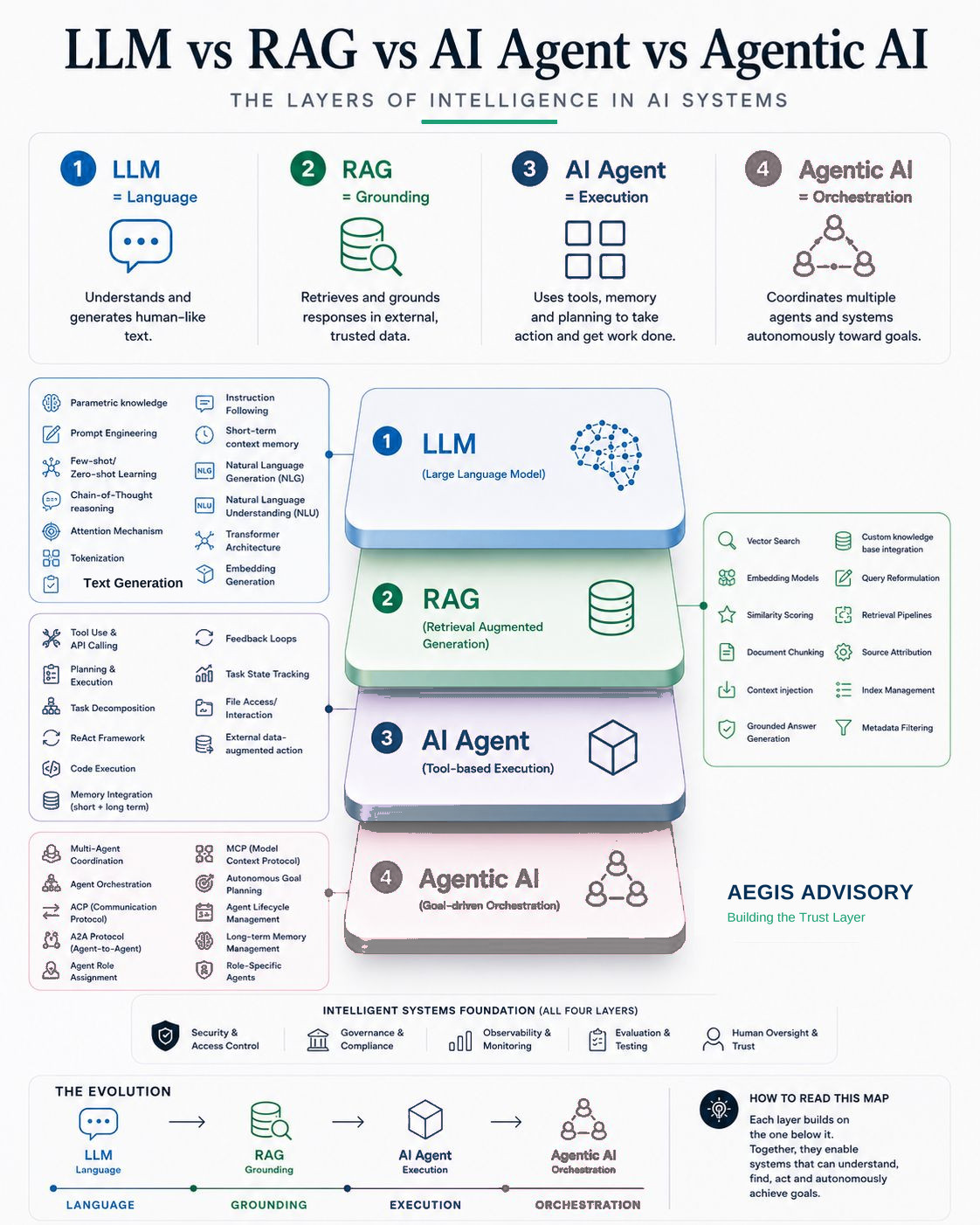
Open almost any serious AI product and you will not find a model working alone. You will find a system: retrieval, memory, tools, permissions, workflows, monitoring, evaluation, governance.
The model is the visible 10% — like an iceberg, except instead of sinking the Titanic, it sinks your Q3 roadmap. The system is where the value actually lives.
- LLMs generate language. That's the whole job description.
- RAG grounds that language in enterprise knowledge — like an electrician grounding a wire. Skip it, and instead of a shock, you get a chatbot confidently offering refunds your company doesn't give.
- Agents connect that intelligence to tools and workflows — this is the part where AI stops talking about doing the dishes and actually does the dishes. Revolutionary, we know.
- Agentic AI coordinates multiple agents toward goals — one model is a musician; this is the full orchestra, assuming none of them wander off to freelance a solo during the compliance review.
Every layer changes what the company needs to have in place before it changes what the model can do:
That's why so many programs stall. They buy the model. They skip the trust architecture. Then they act surprised when the carriage catches fire.
Gartner predicts more than 40% of agentic AI projects will be canceled by the end of 2027. Gartner even has a name for the hype: agent washing. Calling something autonomous doesn't make it governed — calling your carriage a Ferrari doesn't make it one either.
The next AI advantage won't come from who has the best model. Everyone will have frontier intelligence; that part is about to become as differentiated as tap water. The advantage comes from who can safely connect intelligence to work.
Intelligence was never the bottleneck. Trust architecture is.
Your CEO is promising autonomous agents. Your team is still trying to get RAG through compliance. That gap isn't a delay — it's the whole strategy, wearing a disguise.
Building the trust layer is the work. We help growth-stage companies do it without hiring a full-time CIO to run it.