As more leaders evaluate their AI readiness, three patterns keep showing up — regardless of industry, size, or maturity. These profiles come directly from our diagnostic work over the past several months, and they represent the most common operating-model failure points organizations run into when they try to move AI from pilot to production.
None of the three is worse than the others. They're just different diseases, and they need different first moves. Treat a data problem like a governance problem, or a workflow problem like a data problem, and the 90 days get spent fixing the wrong layer while the actual blocker sits untouched.
The three profiles
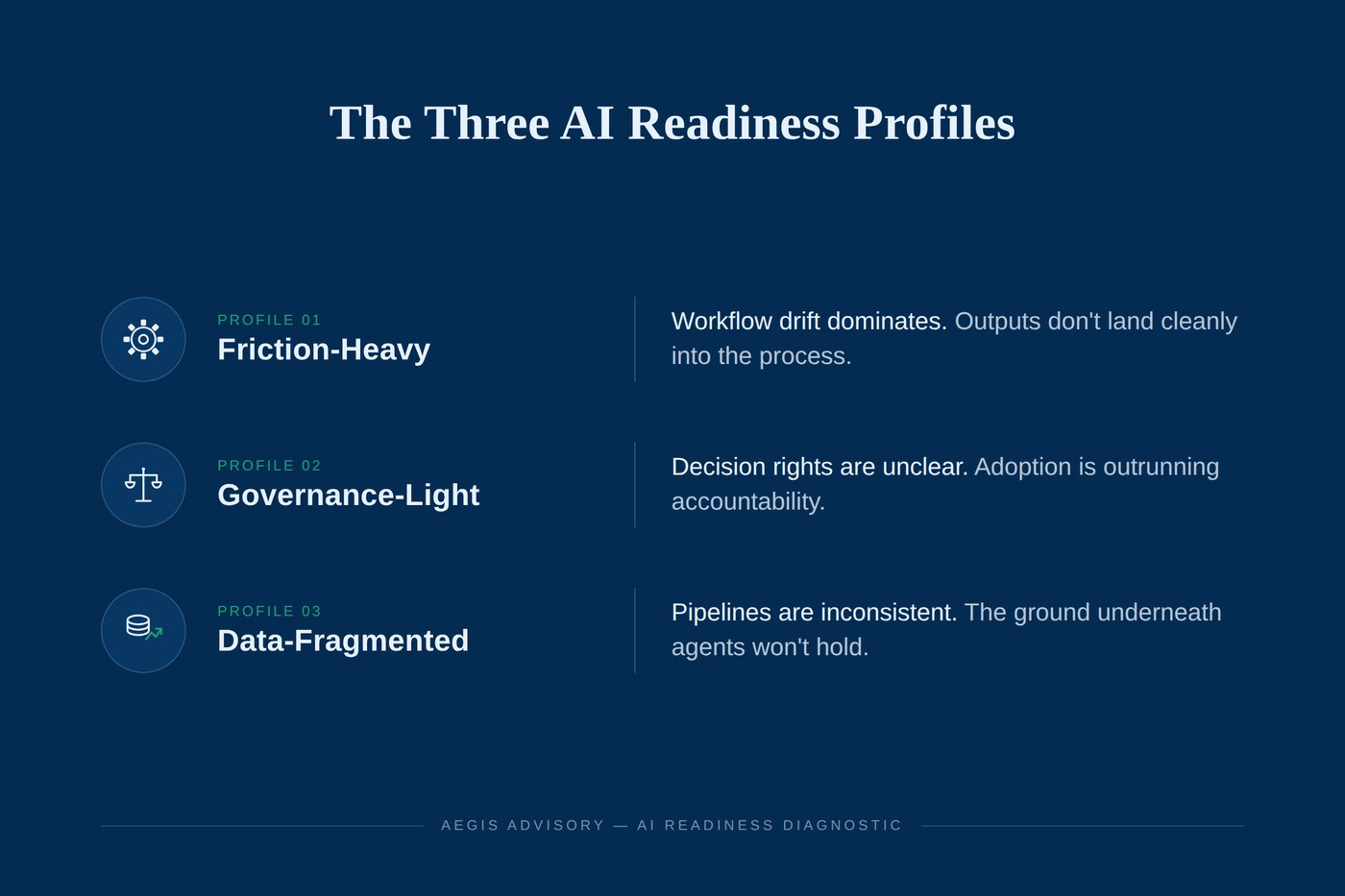
1. Friction-Heavy
Workflow drift dominates. AI outputs don't land cleanly into the process they were supposed to improve, so people route around the tool instead of through it. Autonomy amplifies the misalignment instead of absorbing it — the more independently the system acts, the further it drifts from how the work actually gets done.
2. Governance-Light
Decision rights are unclear, and shadow AI is already everywhere by the time anyone runs the diagnostic. Governance velocity is losing the race against adoption velocity — every week the tools spread faster than the accountability structure meant to contain them.
3. Data-Fragmented
Agents can't operate reliably because the ground underneath them won't hold. Data lineage is unclear, pipelines are inconsistent, and no one can say with confidence where a given input actually came from or which version fed which decision.
Why the wrong starting point stalls the whole initiative
Most stalled AI programs aren't stalled because the model is weak or the use case was wrong. They're stalled because the diagnosis came from whichever department raised the loudest alarm, and that department's alarm doesn't always point at the actual failure layer. A Friction-Heavy organization convinced it has a governance problem will spend its 90 days writing policy nobody's workflow can actually absorb. A Data-Fragmented organization convinced it just needs "AI governance training" will run the training and watch the pipelines stay exactly as inconsistent as before.
The diagnostic exists to catch that mismatch before the 90 days start, not after they're spent. Which pattern is actually driving the stall determines whether the first move is a workflow conversation, an accountability conversation, or a data-engineering conversation — and running the wrong one first is the most expensive mistake we see growth-stage companies make with their AI budget.
Most organizations carry a blend of all three, with one pattern clearly dominant. Naming which one is dominant — honestly, before the vendor pitch or the internal politics shape the answer — is most of the value of running the diagnostic at all.